THE FOUNDING TALE OF THE ALKEB KINGDOM
This popular tale, known as The Pinnacle of the Black Panther, changed many times throughout history due to the passage of time. Different interpretations both in translation and philosophy were attributed to it, sometimes leading to conflicts within the very same tribe, each defending its own historical version.
However, we shall retain only the official version, recorded in the epistemological chronicles of Queen Ki’ZA Batsêt, once taught within the academies of the kingdom and passed down, as the great-grandson of the djēle Mansã Ba once did, from his own lips to the master of my mother, ZA Obamata. In turn, she sang it to me, to my brother Prince YA Odón, and to my half-brother YA Makólinó Mamake, heir to the throne.
This song tells us that tens of thousands of cycles ago, the Celestial messenger MU IDA descended from the stars in the form of an Ancient standing twelve cubits tall, tasked with guiding the first mortals by teaching them art, love, and the essence of life.
Yet during his descent to earth, it was his head that struck the ground first, and he was seized by amnesia. He forgot who he was, his name, where he came from, and even the language of the Celestials themselves. Without guidance or memory, he wandered across the vastness of the world, from jungle to barren desert, aimlessly, until he encountered a panther whose fur and irises shimmered silver.
The feline told him she felt alone, for none within the animal kingdom wished to associate with her, since she resembled none of them. Worse still, even mortals feared her, unable to understand her speech. They heard only muffled roars whenever she attempted to approach and communicate with them.
The Celestial felt alone as well.
Like the panther, he resembled no one else upon these strange lands, and having forgotten his own origins, he could no longer remember who he was or why he existed. So he asked the panther whether she wished to travel the world beside him, for perhaps, in the company of his newfound companion, his memory might one day return.
To his great joy, the panther accepted.
For many cycles, they wandered together through forests, plains, mountains, and deserts, hiding from mortals who hunted them or sought to kill them on sight.
Yet MU IDA and the panther differed greatly in many ways.
The Celestial had no need for food and never slept. He did not age, nor did he suffer from the blazing heat of the orbée or the freezing cold of night. He simply existed, watching the world change around him.
And yet, over time, he felt something awaken within himself, something singular and indescribable that slowly transformed him from the inside.
Something that, many cycles later, would change the face of the world forever.
His faithful companion, the panther, fed on flesh and had to take life in order to survive. She slept during the orbée and awoke at dusk beneath the dying sun. Her temperament, however, never changed: she remained forever fascinated by the world around her, as though rediscovering sight with every awakening.
Her fur shifted color according to her emotions: white, speckled with red circles when she felt joy, yellowish when seized by fear. At times it became black whenever gratitude, melancholy, and an indefinable love overwhelmed her. Even the irises of her eyes changed with her emotions.
When she slept, her brilliant silvery-white coat returned, as though she were reborn.
Yet as the cycles passed, her fur darkened more and more, until it remained permanently tinged with dark gray, only faintly shifting according to her mood. Her eyes, however, lost none of their radiance.
One night, the panther asked MU IDA if he would give her offspring before life abandoned her. The Celestial accepted.
Yet neither could foresee what would come of this union.
To their astonishment, three children were born from it, children whose birth stole the life of their mother, who could not survive bringing them into the world.
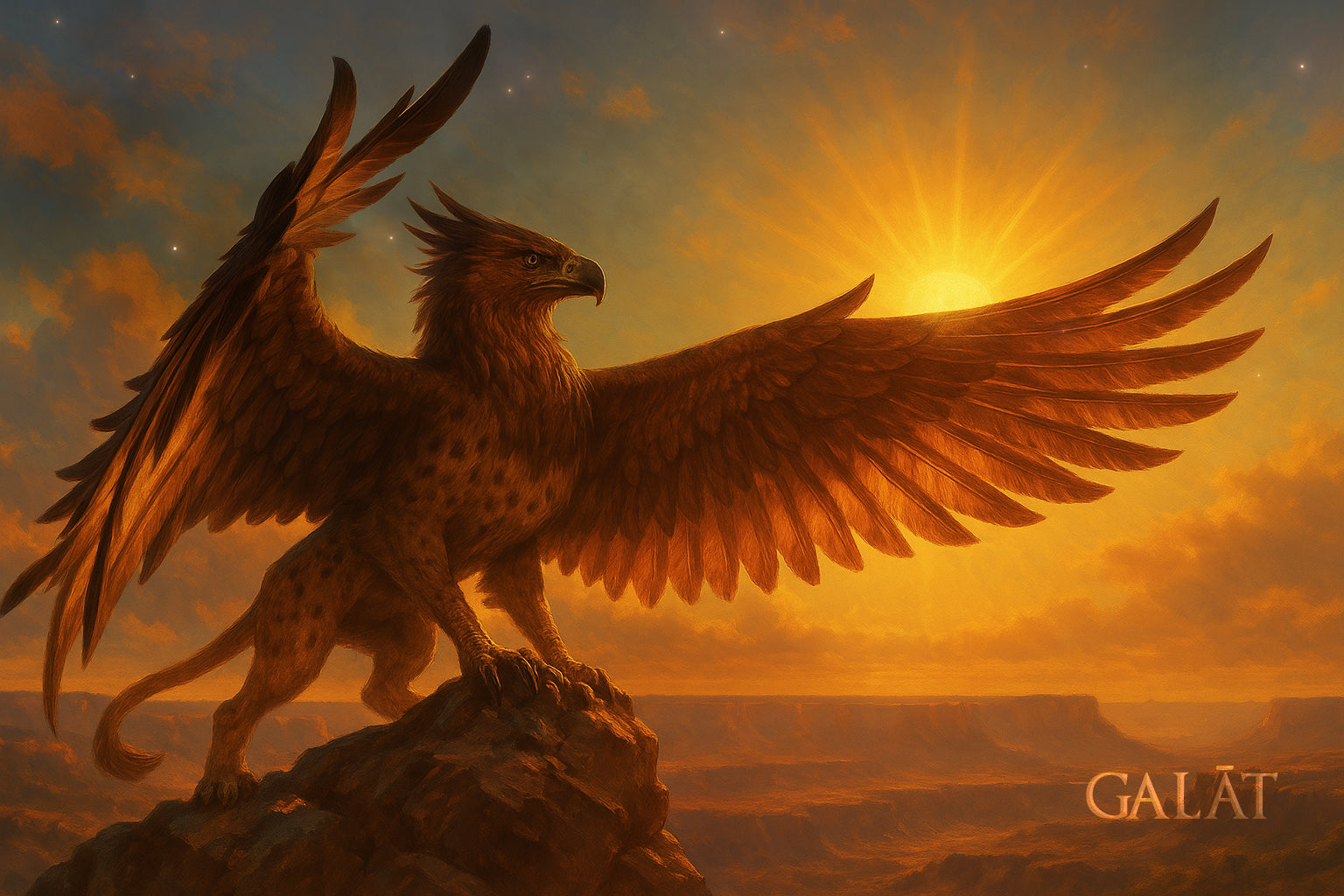
Thus was born GALĀT, he who is said to have named himself.
He is depicted in his most majestic form seated with claws gripping a blazing sun, his immense wings spread far beyond the size of his own body. His head and upper form resemble those of a royal eagle, while his hindquarters bear the features of a great feline.
This Primordial Spirit is often perceived as a near-omnipotent figure. Guardian of time and space, keeper of the secrets of divination, he is invoked by the Spiritual Nomads in their rituals to lift the veil from cycles yet to come.
The Celestial named his second child MĀT.
This Primordial Spirit is at times portrayed as a wolf with the head of an owl, and at others as a tall feline silhouette crowned with an androgynous humanoid face of copper hues, though capable of changing appearance at will.
Sovereign of dreams and night, MĀT is also known to appear where he is least expected, delivering justice and granting wishes. According to countless writings devoted to him, he is the one who may never have possessed a metaphysical body in any form mortals could truly comprehend.
Finally, the last child bore the name MAKŪTA.
King of beasts. Master of speech and endokã.
Of titanic size, he is most commonly represented as a pale panther whose body is covered in countless luminous eyes scattered like stars across his form.
Legend says that each eye possessed its own consciousness.
Myth tells us each eye represents the sins of mortals.
Long before our moons, MAKŪTA became associated with the nundu. My mother ZA Obamata, as well as many before her, claimed these great beasts are in truth descended from him, just as we Mamake are.
Though for thousands of cycles they had been regarded as creatures lost to a vanished world, alongside ghouls and moon tigers, Ki’RË Xangó Mamake VI was blessed by the ênomaji and received the final vials of Water-of-Life containing the tears of the Eternal Yemãa.
These vials were given to my father, Ki’RË Xangó VI, on the very night of his ascension to the throne, as he meditated among the sepulcher-trees of our ancestors within the Jade Forest.
Thus he and his younger brother, Prince YA Tóluwarin, known as YA Tóluwarin the Conqueror, awakened two young beasts named Tiamut and Tiamat, becoming the first Beast-Lords seen in nearly three thousand cycles.
They reconnected with our forgotten heritage, an inheritance nearly lost and mocked by many, inaugurating the new dynasty of the Great Beasts and causing Men from both the Great East and the Great West to fear the roars of the w’nundu.
WHO ARE THE MAMAKE?
The history of the Mamake clan spans more than six millennia, a period during which five dynasties of this bloodline succeeded one another in shaping the destiny of the continent.
It all begins with the almost mythical figure of YA Odón I, founder of the first Mamake dynasty. At a time when the world itself was collapsing, this Moon Elf managed, through the sheer power of his Will, to shatter the “Scourge” that was devastating the planet.
His reign marked the beginning of an era of reconstruction and glory that lasted nearly a thousand cycles. However, this stability was broken when the Dióle clan seized the throne. Forced into exile, the surviving Mamake found refuge on the island of Kózane, among the Tribe of the Southern Waters.
It was during this exile that the clan split apart: a bolder and more daring branch sailed eastward toward the archipelago of the Howling Isles. Upon those hostile lands, they discovered and tamed the nundu, gigantic panthers. This symbiotic bond with those predators became the emblem of their lineage, giving birth to the era of the “Lord-Beasts.”
The decline of this second dynasty is inseparable from the dark reign of RË Sumaoró I. After an unexplained absence of more than a century, during which he was said to have survived within the heart of the dreadful Black Jungle alongside strange creatures, he returned to claim what he believed was his due. Challenged by the great clans, he imposed himself during a “Royal Challenge” against the regent YA Dêmba of clan Yemãa, whom he executed by tearing out his jugular with his teeth.
Despite this victory and his title as king being accepted by the majority of the kingdom’s governors, the new sovereign soon became surrounded by disturbing rumors. Claiming to be the reincarnation of the Celestial MAKŪTA, he maintained a closer relationship with his jaguars than with his own wives, leaving the throne without an heir despite his many marriages within the palace of Zanjãra.
His time in power proved as brief as it was catastrophic. In only four cycles, his disastrous political decisions ignited a war against the Three Moons, shattering an alliance that had endured for nearly two thousand cycles. His end reflected the madness of his reign: he was devoured by his own jaguars, leaving the kingdom in chaos.
What followed was a transitional period lasting nearly four hundred cycles, during which the Kingdom of Alkeb was governed by regents.
Salvation ultimately came from a forgotten member of the bloodline: Odón the Wise. Last in the line of succession, he had long abandoned his noble titles when the Council called upon him. In order to restore the authority of the Mamake, Odón the Wise, the last Mamake of the second dynasty to survive the Three Great Necrotic Wars, followed the example of his founding ancestor by forging a strategic alliance with ZA Zelie Balake, the most beautiful daughter of the Lord of the Seas.
This marriage marked the rise of the third dynasty and the return of stability.
It is also to this king that we owe the motto that still defines the soul of the Mamake clan to this day:
“Elves whose tears are made of honor and gold…”
THE FIFTH DYNASTY OF THE MAMAKE CLAN
After millennia of isolation, a major event occurred in cycle 6121: the Alkeb reestablished contact with humanity following the arrival of Spanish and Portuguese settlers to the Howling Isles.
Humans, who had long relegated the Alkeb to the realm of myths and legends, rediscovered an ancient civilization... Within the Kingdom of Alkeb, this period was also marked by major dynastic events.
In 6126, Princess ZA Yenara Mamake was born, the second child of Ki’RË Xangó VI. Eight cycles later, Alkeb and Humans signed their first interspecies peace treaty, inaugurating nearly a century of uneasy cooperation. The ports of the Howling Isles and Kagatonde became major maritime crossroads, serving Spanish and English corsairs, slave ships, and pirates alike.
The Alkeb traded with Humans and imposed tributes for the exploitation of their waters, while human caravels crossed their territories carrying enslaved people from West Africa toward Brazil and the Caribbean.
The Mamake clan further strengthened its lineage with the birth, in cycle 6172, of Princess Ki’ZA Sãma Mamake, daughter of YA Tóluwarin the Conqueror, Prince of the Western Lands and younger brother of the future king Ki’YA Xangó Mamake.
In cycle 6204, Prince Ki’YA Xangó ascended the throne under the name Ki’RË Xangó Mamake VI. Together with YA Tóluwarin, he attained the rank of Lord-Beast after receiving the last vials of the Elixir of Life-Water, capable of transforming nundu into gigantic nundu.
Several beasts were awakened in this manner, among them Tiamat and Tiamut, the latter becoming the mount of his younger brother. The final vial was offered to the panther of his eldest son, Crown Prince YA Makólinó Mamake.
The following cycle, YA Makólinó was officially proclaimed heir and granted the title of Prince of the Nār. He settled within his palace of Mõmila alongside his wife, the new Lady of the Nār, and his w’nundu.
In 6215, Prince YA Tóluwarin Mamake went to war against Humans in Brazil following the death of his wife, and founded the great city-state of Jansabula. Two cycles later, his daughter, Princess Ki’ZA Sãma Mamake, married YA Kasimbe Balake, son of the Lord of the Seas.
In the south of the Alkeb Kingdom, long-standing tensions erupted in 6223 with the beginning of the Obsidian Lands War, when human settlers attempted to invade the Three Moons, starting with the island of Kózane. The following year saw the death of the Lord of the Seas, YA Oluwarótimi Balake, who perished during a naval battle; his son YA Kasimbe Balake succeeded him that very same year.
The war ended in 6229: the Alkeb deported the Humans to Kagatonde, where they were forced to work in the mines of the Nindjiama region, soon renamed Grisefer.
On the other side of the Atlantic, the death of Prince YA Tóluwarin in 6277 sparked the first rebellions in Jansabula, dividing the city-state into several districts where human factions fought for control of the trade routes. In 6290, Princess Ki’ZA Sãma was finally sent by the king to govern the territory.
But in 6331, she was stripped of all her titles after slitting the throat of her own child during a magical ritual supposedly meant to grant her greater power, while she was confronting the army of the Lord of the Seas following her betrayal with his son.
She later became known as The Dark One and renamed Jansabula to Intuló, severing all ties with the legacy of her father and the Alkeb Kingdom.
A major turning point occurred in 6351 with the liberation of the Humans of Kagatonde and the signing of the Treaty of Grisefer, ushering in a new era of cooperation. Kagatonde nevertheless remained under the supervision of Órelota, administered jointly by a council of high-ranking Human dignitaries and the Council of the Guide.
Cycle 6367 saw the birth of the last son of Ki’RË Xangó Mamake: Prince YA Odón Mamake, future bearer of the title Spear of the King.
In 6393, the Interspecies Alliance for Peace and Commerce (IAPC) was founded in Kagatonde, uniting the kingdom’s three intelligent species: Humans, Alkeb, and the Akwananmba.
After Brazil’s independence in 6410, Intuló nevertheless remained under the control of The Dark One. However, the first revolutionary insurgent groups began challenging her rule in the north and west, while the Ogunge clan drew closer to The Dark One and, beginning the following cycle, initiated the importation of gurgia roots throughout Latin American territories.
The Mamake clan also expanded its influence into Africa. In 6425, the king established the first leopard-men (aniota) camp in the Congo and sent there the kingdom’s prisoners, illegitimate children, and members of defeated clans so they could be trained to fight, and kill, in service of the Alkeb Kingdom with their very lives.
In 6446, Prince YA Oluwasë Mamake was born, son of the heir YA Makólinó Mamake and Mëa Neferktari Mamake, Lady of the Nār.
The abolition of slavery in Brazil in 6476 profoundly disrupted the region’s economic and social balance.
The new century opened tragically in 6500, when an earthquake triggered a volcanic eruption followed by a devastating tsunami upon Kózane and part of Namale.
In 6534, YA Samba Ogunge, a close ally of The Dark One, became Guide of the Kingdom, appointing YA Musa, Manzi, and Afóle as emissaries.
Three cycles later, an international drug trade began to emerge, involving cocaine, gurgia cultivated in Alkebula, and cannabis, orchestrated by The Dark One, the Ogunge clan, and several Human networks.
In 6539, through an unprecedented joint diplomatic effort led by several high-ranking Human and Alkeb dignitaries, the Alkeb Kingdom joined the BIRA, a transatlantic alliance uniting Brazil, Intuló, and the Alkeb Kingdom.
Thanks to this cultural, economic, and diplomatic alliance, the Guide founded the FMIA (Alkeb International Monetary Fund) in 6546.
In 6560, the South African corporation NexusLab, owned by the Order of Shéol, developed the first RFL serum and launched the Paladin Program.
Cycle 6575 marked a double turning point: the deployment of the first legionary squadron of the Order of Shéol in Israel, commanded by the Paladin Suriel, and the São Paulo Convention held during the 12th BIRA Summit. There, the emissary Manzi advocated for the recognition of the FMIA by the Human Nations, as well as for the regulated circulation of Alkeb within the Human world.
The following decades proved unstable.
Olivia Dubois was born in 6584 in the Marshes of Belgium, followed by her sister Valnia in 6588.
Cycle 6584 also marked South Africa’s entry into the BIRA during the 15th Summit, transforming the alliance into the BIRAS, with South Africa becoming the fourth founding nation of the assembly. Several peace treaties, along with commercial and cultural exchange agreements, were signed between the member states.
In 6586, the first colars appeared and were rapidly adopted within prison systems around the world to control the mirroring abilities of the Alkeb, particularly in Brazil and South Africa.
The 19th BIRAS Summit, held in Luanda in 6596, resulted in a new peace treaty. Several nations, including Cuba, Haiti, Venezuela, and multiple African countries with large Alkeb diasporas, were granted observer status for future summits.
That peace, however, collapsed in 6597, when both the European Union and Brazil enacted major Shéolite reforms, hardening their policies toward the Alkeb and extending genealogical investigations from three generations to four.
In 6599, Belgium was shaken by the crimes of the Hammer Killer, Peter Merten, whose path crossed that of our heroine, Olivia Dubois, while she was still only a teenager.
It was on that day that Olivia Dubois died, slowly giving way to the Naked Spirit...
Share the article:
THE LADY OF THE TIDES
THE DARK ONE