


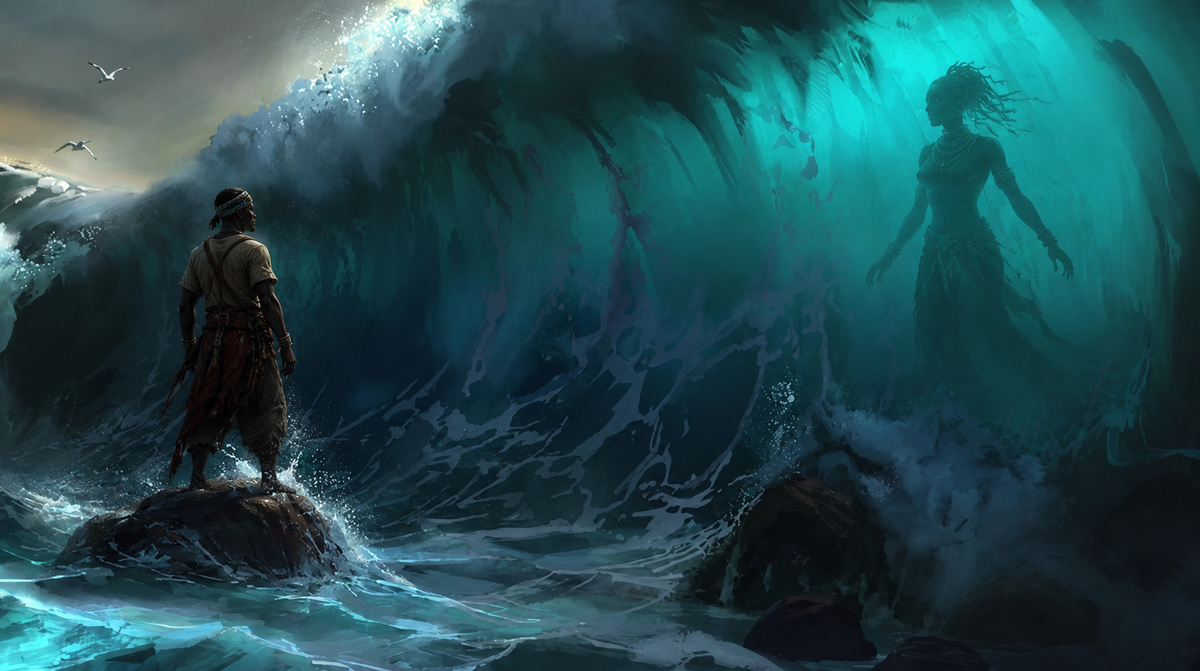
According to certain very old beliefs reported among the inhabitants of northern Alkebula, and more particularly within the North Water Tribe, YËMÃA is among the first Eternals whose name appears in the works attributed to the Aziza sister and djēli, Satna Nãla. The oldest accounts state that she was originally an elf of exceptional beauty.
Her death is said to have occurred by accidental drowning while, as every morning, she was crossing a wooden bridge with a handle of water on her head, coming from a well not far from her village.
Legend has it that a Maxetani, furious at the thought of no longer being able to gaze upon her beauty after her demise, cursed her so that she would forever appear as a reflection on the surface of bodies of water.
Although the preserved texts on the origin of the Eternal YËMÃA are dated to the third millennium of the Second Era, it is established by historical cross-referencing that the Yemãa clan already existed long before this period. It dates back to the time of the Three Builder Clans, of which it was an integral part, more than three thousand years ago.
Historians thus assume that, in one way or another, the first Moon elves were already aware of this Eternal at the time of the clan's founding, and that her worship largely preceded her written documentation.
Over the centuries, the Yemãa clan naturally developed in the swampy regions, along rivers and around waterways, over a vast part of Galāni. Over time, alliances, interbreeding, and migrations, this clan gave rise to several branches that eventually abandoned the original name to adopt others.
Although the Yemãa clan is not the origin of the medicinal discipline of the Ênomaji, it is unanimously recognized as the founder of the spirit-calling baptismal ritual, still practiced by the Spiritual Nomads.
This ancestral ritual brings together several Aziza, shamans, Kizoyu, Ênomaji, G’mindje, Djēle and always takes place under the presidency of members of the Spiritual Tribe. It is held near a waterfall, on the edge of the great lake of Galāni. Participants sing a specific chant while performing a dreamlike ritual mixing the art of the Ênomaji, in order to make their endokã shimmer on the surface of the water and call the spirits of a specific individual.
This person, usually isolated several hundred meters away, stands waist-deep in the lake. While the chants echo in the distance, they perceive in the reflection of the water, beside them, the spirits of some of their ancestors.
The encounter, of rare intensity, takes place at night, under the moon, and lasts for the duration of the chant, between ten and fifteen minutes. At the end of the ritual, the chants gradually fade and the spirits return whence they came, leaving the initiate profoundly moved. This baptism is most often reserved for young Djēle, Kizoyu, Aziza sisters, shamans, and more recently for the G’mindje.
Furthermore, several clans and communities from the North Water Tribe worship the Celestial NU’OYA, a name attributed by the first King-Shaman. In Alkeb cosmology, this deity is frequently associated with, or even confused with, the Eternal YËMÃA. Other djēle claim that YËMÃA is the daughter of NU'OYA, while others assert that they are two distinct entities...
The inhabitants of these regions have made it a habit to solicit her through prayer and song, mainly near waterways. However, YËMÃA is renowned for her discreet and untamed nature. She only manifests under specific conditions and only as a reflection on vast bodies of water: large rivers, streams, lakes, or the sea.
She never communicates by speech and exerts no direct physical influence on the visible world, unless she decides to, always through the medium of aquatic reflections.
To hope to attract her, it is necessary to charm her with songs and pleasant fragrances, especially those of the lily, a flower found in abundance in northern Alkebula. Shamans use incense for this or scatter lily petals on the water's surface during rituals invoking her presence.
Legend has it that the Yemãa clan won many of its battles thanks to the prolonged mastery of this secret ritual, of which it was the sole holder for centuries.
This knowledge, although gradually disseminated within the community of Spiritual Nomads, did not truly spread outside of Galāni until the reign of RË Asane I. Since then, the ritual of calling Yëmãa has been widely adopted by shamans from the South Water Tribe, particularly in the Three Moons regions, as well as in some rarer places in Ansasiwa.
Although manifestations of Yëmãa remain rare in contemporary times, the glorious songs and stories evoking the ancient members of the Yemãa clan calling the Eternal on battlefields, to engulf their enemies beneath the floods, are still transmitted and sung by many djēle today.
Several accounts dating back millennia also report that it was the Yemãa who, through the intercession of the Eternal, offered the Mamake the Water of Life. Legend has it that when the Mamake decided to rebel against the Dióle, a djēle loyal to the Mamake clan sought the help of several clans to meet their goddess.
Only the Yemãa clan responded to this call and agreed to be the intermediary.
During the ritual, led by the shamans, the djēle recounted to the Eternal Yëmãa the great epics of the Mamake clan and the dream of the Bearer of Dawn, a mythical figure with whom all Mamake princes and suzerains sought to identify. He spoke of the failures of previous Orun kings and accused the reign of YA Jalãni Dióle of being the cause of human death and the suffering that afflicted the world, claiming that only the Mamake could put an end to it.
Moved by this story, and by the words of this djēle, the Eternal, or more precisely her reflection, reportedly began to cry with emotion. The shamans then collected her tears in a carafe. From these tears, the Water of Life was born, capable of transforming nundu into w’nundu.
Finally, chronicles report that in the era preceding the discovery of the Three Moons, YA Kozane Mamake, cousin of the reigning king of the first dynasty of the Mamake, embarked on a journey westward to find a way to cross the Xanāre River of Galāni, hoping to reach uncharted lands.
He found assistance from several sailors, Namale and Wagadu, both renowned for their fishing skills and their knowledge in building large rafts, thanks to which the expedition could be undertaken. Less than 1 year after their expedition, they finally landed with 36 sailors, out of the 200 who initially set off, on the sides of the three crescent-shaped volcanic islands south of Alkebula.
They then named the three islands after themselves, Kozane, Wagadu, and Namale, and together laid the foundations of the South Water Tribe, which would, over time, distinguish itself from their northern counterparts by their expertise in navigation and their strong inclination for piracy.
Share the article:
JESSY
SAUDA